
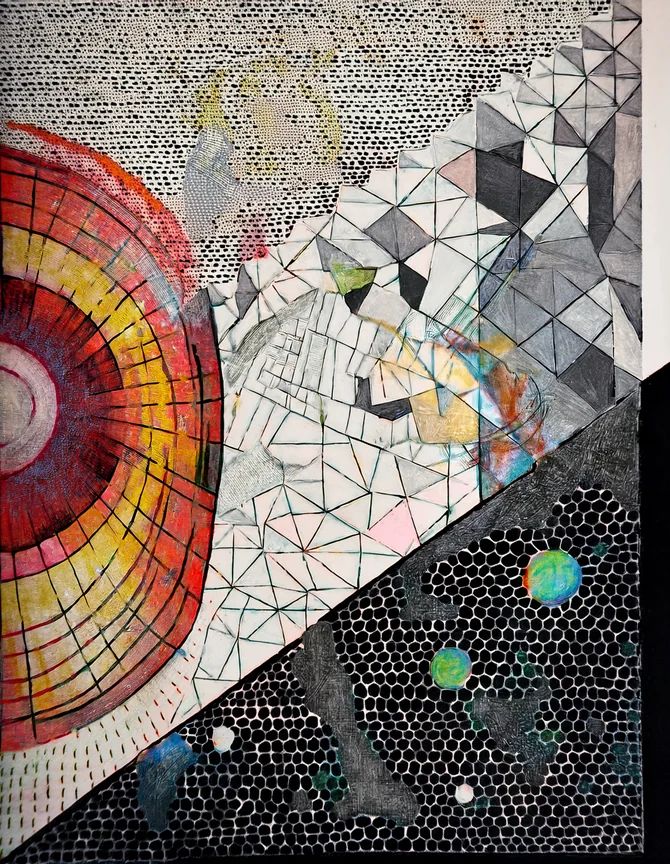
Hexagram 49 · 革 Gé
The Molting
Fire within · Lake without
This is a needed radical change — revolution, the molting of the old skin for the new, the overturning of what has outlived its mandate. The figure's governing theme is timing and trust: "on your own day you are believed" — revolution succeeds only when its time is genuinely ripe and it has been made credible. The line texts trace the whole arc: bound firm at the start, not yet time (line 1, the yellow oxhide); when one's own day comes, then act (line 2); neither rush nor dawdle — when the need has been thoroughly weighed ("talk of revolution gone round three times"), commit and be believed (line 3); the turning point, trusted, changing the very form of things (line 4); the great man's tiger-bright transformation, believed at once (line 5); and, after, the superior refines himself further like a panther while the inferior at least molts outwardly — now consolidate, do not keep overturning (line 6). Radical change is right, but only in its ripe time and made trustworthy.
- Inner · Outer
- ☲ Fire · ☱ Lake
- Hands
- Attention · Love
- Turned view
- 50 The Refining Vessel
- Complement
- 4 The Unformed Mind
- Nuclear
- 44 The Return of the Other
This figure has thirteen parts. Six are always open here; one more opens each week.
About 900 of its 3100 words
- 01The Figure
- 02The ForcesIn the full figure
- 03The BodyIn the full figure
- 04The Situation
- 05The Interval
- 06The Family FieldIn the full figure
- 07The Facing FiguresIn the full figure
- 08Calibration
- 09The Arena Question
- 10Weather
- 11The Unhanding NoteIn the full figure
- 12The Six Lines
- 13Source NotesIn the full figure
05 · The Interval
The interval here is crossed by timely transformation — the gap between what is and what could be is bridged by shedding the old for the new when the time is genuinely ripe. The task is the well-timed, credible revolution: to wait, bound, until one's own day (not to force change prematurely); to weigh the need thoroughly before committing; to make the change evident and trustworthy (the tiger's bright pelt); and then, once made, to consolidate rather than keep overturning. What crosses this interval is the change whose day has come.
08 · Calibration
Deficiency
the change refused past its
day Failing to shed the old when its time has truly come — clinging to the outlived mandate, the molt refused, the revolution that should have happened left undone.
Alignment
the timely molting
The change whose day has come, made evident and trustworthy: waiting bound until the ripe moment, weighing the need thoroughly, transforming clearly (the tiger's bright pelt), and then consolidating. The natural, timed shedding of the old skin for the new.
Excess
the premature or perpetual
revolution Change forced before its day (line 3's rash “starting brings misfortune”), or change that never stops — perpetual overturning that will not consolidate (line 6's warning). Revolution become rashness or permanent chaos.
Which way it tends. Toward the refused or the rash: either the change is clung against past its day (the molt refused) or forced before its time and never consolidated (perpetual upheaval). Toward the timely molting: the change waits for its ripe day, is made evident and trusted, overturns the outlived order, and then consolidates — on your own day you are believed.
09 · The Arena Question
What here has outlived its mandate and needs shedding — and has its day truly come, made evident and trustworthy, or would I be forcing change before its time?
Arenas ossify; orders outlive their mandate and need overturning. The figure's arena question is about ripeness and credibility: has the day for this change genuinely come, and can you make it evident and trusted — or would you be forcing a premature revolution that will be disbelieved? The costly errors are the refused change (clung past its day) and the rash or perpetual one. Ask whether the time is truly ripe, whether the need has been thoroughly weighed, and whether the change can be made clear enough to be believed.
10 · WeatherOpen this week
A part from the full figure, open to everyone this week. The same figure reads differently depending on the weather you cast it in.
Dark night
revolution in a dark time is where the pressure to force change prematurely is strongest: the dark makes the old order unbearable and tempts the rash overturning before its day. The counsel — wait, bound, for the true day even in the dark; the dark-night error is the premature revolution. Watch the excess: darkness rushes the molt.
Bright day
the need and the ripeness both clearly seen: the best weather for the evident, credible, well-timed revolution (the tiger's bright pelt seen by all). The figure's strongest weather — change made luminous and trusted. Act when the day is clear.
Mundane day
the ordinary, gradual shedding of the outlived: the daily molting of old habits, forms, and arrangements as their time quietly passes. The figure's quieter home — most transformation is a slow, ordinary shedding, not a sudden overthrow.
12 · The Six Lines
One arc: revolution from the bound start through the ripe day, the weighed commitment, the trusted turning, and the tiger's bright change, to the post-revolution refinement and consolidation. Read as the timely, credible shedding of the old for the new. (The family's most-formed member.) Each line, when it moves, carries the figure somewhere else.
Line 1becomes 31 The Wooing →
Wrapped in the hide of a yellow cow.
At the very start, one is "wrapped in the hide of a yellow cow" — bound firm and still, held in check: it is not yet the time to make revolution, and one must hold, restrained, until the day is ripe.
Premature change at the outset fails; the yellow oxhide binds one to patience. The counsel: at the beginning, it is not yet time to overturn anything — hold
The full reading of this line · about 120 words
Line 2becomes 43 The Resolute Breakthrough →
When one's own day comes, one may create revolution. Starting brings good fortune. No blame.
The turning of timing: "when one's own day comes" — when the moment is genuinely ripe — then one may make the revolution, and to begin brings good fortune, no blame.
Everything waits on the day; once it has truly come, action is right and fortunate. The counsel: when the ripe day has genuinely come, act — make the
The full reading of this line · about 110 words
Line 3becomes 17 The Following →
Starting brings misfortune. Perseverance brings danger. When talk of revolution has gone round three times, one may commit, and men will believe.
The figure's counsel against both haste and delay: to start rashly brings misfortune, but to merely persevere in the old brings danger too — so the middle way is that when "talk of revolution has gone round three times," when the need has been thoroughly weighed and voiced and confirmed, then one may commit, and people will believe.
Neither lunge nor cling; weigh it fully, then act with credibility. The counsel: do not rush the change nor cling to the old — weigh the need thoroughly
The full reading of this line · about 130 words
Line 4becomes 63 The Completed Crossing →
Remorse disappears. Men believe him. Changing the form of government brings good fortune.
The revolution's turning point: remorse disappears, "men believe him," and changing the very form of things — the mandate, the order, the government — brings good fortune.
Here the change actually happens and is trusted: the old form is genuinely transformed, and because it is believed, it holds. The counsel: at the turning point, when
The full reading of this line · about 120 words
Line 5becomes 55 The Noonday Height →
The great man changes like a tiger. Even before he questions the oracle he is believed.
The figure's summit of trust, at its ruling seat: "the great man changes like a tiger" — his transformation is as clear, striking, and evident as a tiger's bright new pelt, its markings bold and unmistakable — so that he is believed even before the oracle is consulted.
The great transformation, made luminous, needs no confirmation; its rightness is self-evident. The counsel: let the change be as clear and striking as a tiger's bright new coat
The full reading of this line · about 130 words
Line 6becomes 13 The Open Fellowship →
The superior man changes like a panther. The inferior man molts in the face. Starting brings misfortune. To remain persevering brings good fortune.
After the revolution, the finer, quieter work: the superior person "changes like a panther" — refining himself further, the panther's subtler and more intricate markings, the inner transformation continuing after the outer one; while the inferior at least "molts in the face," changing outwardly, obediently accepting the new order even if not inwardly transformed.
And the warning: now starting further upheaval brings misfortune — the time for revolution is past; to persevere in and consolidate the new order brings good fortune. The
The full reading of this line · about 160 words
Also in this figure
Where it lives in your body, who it moves with, and the trap it sets.

The Changes · Mikono Tisa
Sixty-four figures. Every part, every line, every painting.
730 pages · 64 original paintings · the Nine Hands mapped onto the eight trigrams · no verdicts, only trajectories.
The reading room
$5 / month
or $45 a year. The whole book online, every figure in full, 20% off readings.
Opening soon — join the letters to hear first.
The book
$50
The illustrated digital edition to keep, with three months of the reading room.
Opening soon — join the letters to hear first.
Want this figure read for your situation? Book a reading with Nathaniel