
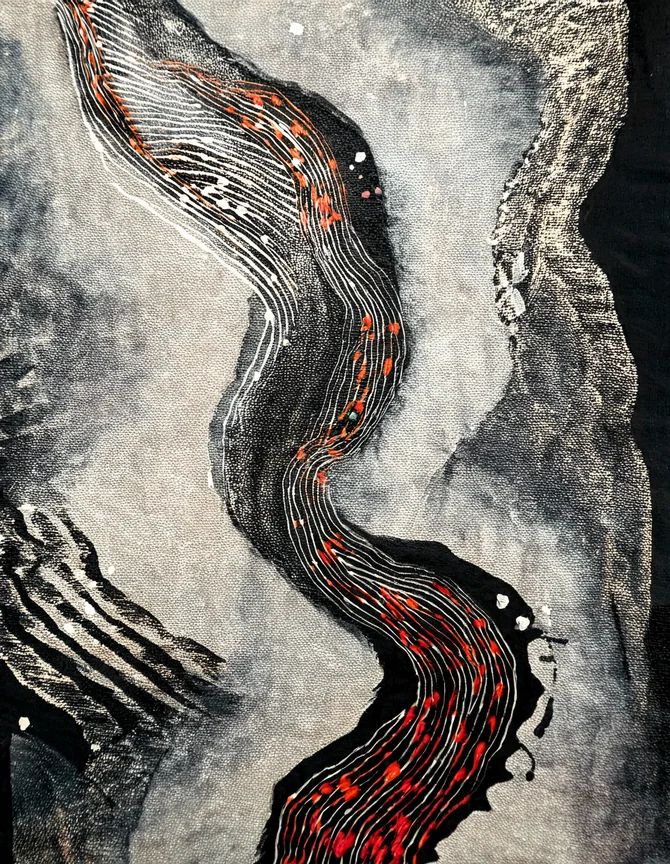
Hexagram 56 · 旅 Lǚ
The One Passing Through
Mountain within · Fire without
This is a time of transience — being a stranger, a traveler, passing through unfamiliar ground with no fixed home or standing. Something has set you in motion or out of place: you are the newcomer, the guest, the one without established position, moving through territory that is not yours. The figure's counsel is modest and exact: success comes through smallness and correctness — the stranger who is modest, careful, and self-possessed fares well; the one who is arrogant, petty, or careless loses even the little shelter they find.
- Inner · Outer
- ☶ Mountain · ☲ Fire
- Hands
- Inner Sovereignty · Attention
- Turned view
- 55 The Noonday Height
- Complement
- 60 The Measure
- Nuclear
- 28 The Overloaded Beam
This figure has thirteen parts. Six are always open here; one more opens each week.
About 800 of its 2900 words
- 01The Figure
- 02The ForcesIn the full figure
- 03The BodyIn the full figure
- 04The Situation
- 05The Interval
- 06The Family FieldIn the full figure
- 07The Facing FiguresIn the full figure
- 08Calibration
- 09The Arena Question
- 10Weather
- 11The Unhanding NoteIn the full figure
- 12The Six Lines
- 13Source NotesIn the full figure
05 · The Interval
The interval here is crossed while in motion, without a fixed base. The gap between what is and what could be must be closed by one who has no home to close it from — the traveler crossing unfamiliar ground. The task is to carry your center with you (the mountain within) and stay alert (the fire without), making the provisional shelters and connections that transience allows without either clinging to them (they are temporary) or despising them (they are what you have). The wanderer crosses by carrying home inside and meeting the road with self-possessed attention.
08 · Calibration
Deficiency
the petty stranger
Collapsing into anxious smallness as a traveler: busying yourself with trifles (line 1), losing dignity, becoming the fearful newcomer who fusses over trivia and draws misfortune. The wanderer who has lost their inner center and become merely small.
Alignment
the self-possessed wanderer
Carrying your center and dignity through transience without shrinking into pettiness or swelling into arrogance; staying alert in strange ground; making the adaptive connections that shelter you; modest and correct.
Excess
the arrogant stranger
Carrying yourself as though you had established position when you do not: arrogance that burns down the inn and loses the loyal help (line 3), carelessness that burns the nest (line 6). The traveler who forgets they are a guest — the great-exceeding breaking out as the stranger's hubris.
Which way it tends. Toward the petty or arrogant stranger: the traveler either shrinks into anxious smallness or swells into hubris — both lose the provisional shelter transience requires. Toward the self-possessed wanderer: the stranger carries their center and clarity, makes adaptive connections, and passes through well — success through smallness.
09 · The Arena Question
Where am I a stranger here, and am I carrying myself as a self-possessed guest — or as a petty or arrogant one?
Arenas make wanderers of us — the new job, the unfamiliar field, the place where you have no standing yet. The figure's arena question is about how you occupy the stranger's position: are you carrying your center and making adaptive connections, or shrinking into anxious pettiness, or overreaching your provisional standing into arrogance? The costly errors are both failures of the guest — the trifling small stranger and the hubristic one who burns the inn.
10 · WeatherOpen this week
A part from the full figure, open to everyone this week. The same figure reads differently depending on the weather you cast it in.
Dark night
the wanderer in a dark night is transience at its hardest: strange ground with poor visibility, no home, the center tested. The counsel holds — carry your inner mountain, stay alert, value any shelter found. Watch the deficiency — a dark night tempts the traveler into anxious pettiness or despair. Keep your dignity; the road continues.
Bright day
clear passage through unfamiliar ground: you can see the terrain, find shelter, use your gifts, make connections. The best weather for the wanderer's success through smallness. Watch the excess — bright-day confidence can tip the stranger into arrogance, forgetting they are still a guest.
Mundane day
the ordinary passage: the unremarkable stretch of being a newcomer, quietly self-possessed, making small adaptive connections without drama. The wanderer's sustainable way — home carried within through an ordinary strange day.
12 · The Six Lines
One arc: the wanderer from the petty trifling to the burning of the nest. Read as the carriage of the stranger. Each line, when it moves, carries the figure somewhere else.
Line 1becomes 30 The Clinging Light →
If the wanderer busies himself with trivial things, he draws down misfortune upon himself.
At the start of the journey, the wanderer who fusses over trifles, who occupies themselves with undignified small concerns, draws misfortune.
The error is the collapse into pettiness — losing one's center and dignity as a stranger and becoming merely small and anxious. The counsel: carry yourself with dignity
The full reading of this line · about 100 words
Line 2becomes 50 The Refining Vessel →
The wanderer comes to an inn. He has his property with him. He wins the steadfastness of a young servant.
The realized form of the hand: the wanderer finds an inn (provisional shelter), keeps their property (resources intact), and wins the loyalty of a young servant (adaptive connection, help gained through correctness).
This is the wanderer's way done well — modest, self-possessed, making the provisional arrangements and genuine connections that carry a stranger through. The hidden relational core surfacing: the
The full reading of this line · about 100 words
Line 3becomes 35 The Rising Light →
The wanderer's inn burns down. He loses the steadfastness of his young servant. Danger.
The inn burns down and the loyal servant is lost — the wanderer, through arrogance or carelessness, destroys the very shelter and help that line 2 secured.
Danger. This is the excess in the wanderer's key: forgetting one is a guest, overreaching one's provisional standing, and losing the provisional goods that transience had granted. The
The full reading of this line · about 110 words
Line 4becomes 52 The Held Boundary →
The wanderer rests in a shelter. He obtains his property and an ax. My heart is not glad.
The wanderer finds a resting place and obtains property and an ax (means and a tool of defense) — a measure of security — and yet "my heart is not glad." Even with shelter and resources, the stranger is not at ease, because they remain a stranger; the security is real but provisional, and the heart knows it.
The counsel: accept the partial security without mistaking it for home, and do not expect the gladness that only a true place would bring. Rest, but lightly.
The full reading of this line · about 120 words
Line 5becomes 33 The Timely Retreat →
He shoots a pheasant. It drops with the first arrow. In the end this brings both praise and office.
The wanderer uses their genuine gift — shoots a pheasant and fells it with a single arrow, displays real skill — and in the end this wins both praise and office: recognition, even standing, earned by demonstrated excellence despite being a stranger.
The counsel: your genuine gifts travel with you and can earn you recognition even where you have no established position. Use what you truly do well; it is
The full reading of this line · about 110 words
Line 6becomes 62 The Low Flight →
The bird's nest burns up. The wanderer laughs at first, then must lament and weep. Through carelessness he loses his cow. Misfortune.
At the top — the most elevated a wanderer can be, and therefore the most precarious — the bird's nest burns up.
The wanderer laughs at first (careless, secure-seeming) and then must lament and weep, and through carelessness loses even their cow (their basic sustenance). Misfortune. This is the excess
The full reading of this line · about 150 words
Also in this figure
Where it lives in your body, who it moves with, and the trap it sets.

The Changes · Mikono Tisa
Sixty-four figures. Every part, every line, every painting.
730 pages · 64 original paintings · the Nine Hands mapped onto the eight trigrams · no verdicts, only trajectories.
The reading room
$5 / month
or $45 a year. The whole book online, every figure in full, 20% off readings.
Opening soon — join the letters to hear first.
The book
$50
The illustrated digital edition to keep, with three months of the reading room.
Opening soon — join the letters to hear first.
Want this figure read for your situation? Book a reading with Nathaniel