
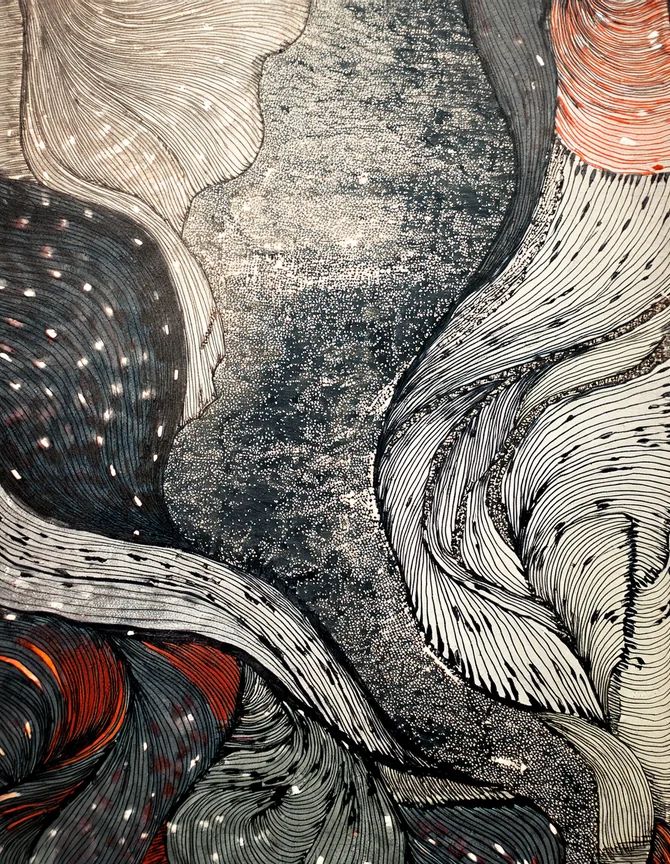
Hexagram 57 · 巽 Xùn
The Patient Entering
Wind within · Wind without
This is a moment for gentle, repeated, adaptive influence — not force, not a single decisive stroke, but the patient entering that finds the gaps and works by persistence. Something cannot be pushed; it must be seeped into. The situation yields to the small, iterative, tested approach that adapts to what it meets, and resists anything sudden or heavy.
- Inner · Outer
- ☴ Wind · ☴ Wind
- Hands
- Experimentation · Experimentation
- Turned view
- 58 The Open Exchange
- Complement
- 51 The First Strike
- Nuclear
- 38 The Estrangement
This figure has thirteen parts. Six are always open here; one more opens each week.
About 700 of its 2800 words
- 01The Figure
- 02The ForcesIn the full figure
- 03The BodyIn the full figure
- 04The Situation
- 05The Interval
- 06The Family FieldIn the full figure
- 07The Facing FiguresIn the full figure
- 08Calibration
- 09The Arena Question
- 10Weather
- 11The Unhanding NoteIn the full figure
- 12The Six Lines
- 13Source NotesIn the full figure
04 · The Situation
The figure has no counterforce in it. There is no ground to stop the wind, no shock to make it sudden — only gentle entering, within and without, repeated.
05 · The Interval
The interval here is crossed gradually, by many small passages. The gap between what is and what could be does not close in a single move; it is entered again and again, each probe going a little further, each pass adapting to what the last one found. The figure's whole method is iteration — and its whole danger is iteration without end. The task is to keep entering until the influence lands, and then to stop entering: to let the experiment become a commitment rather than an endless probing.
08 · Calibration
Deficiency
the untested assumption
Rigidity, the refusal to probe, acting on unexamined assumption, fear of trial. Never running the experiment; treating the first idea as the final one.
Alignment
the probe that lands
Iterative small influence that genuinely learns from each pass and then commits to what it has found; testing in service of finding the real path, not of avoiding the decision. The wind that enters, adapts, and finally arrives.
Excess
the endless tinkering
Probing that never commits, testing as a way of avoiding decision, the repeated penetration that bores in forever and lands nowhere. Adjustment become procrastination — the experiment that will not conclude because concluding means risking a result.
Which way it tends. The figure turns on one distinction: iteration that lands versus iteration that never commits. Toward untested rigidity or endless tinkering: either the experiment is never run or it is run forever without conclusion. Toward the probe that lands: the iteration learns and then commits — the hunt that catches its game, the influence finally arriving where repeated gentle pressure was aimed.
09 · The Arena Question
What here can only be entered gradually, and is the endless probing mine or the arena's?
Some arenas genuinely yield only to patient, repeated influence — and some arenas induce endless tinkering, a culture of perpetual iteration that never ships, never commits, never lands. Ask whether the situation truly requires the slow entering, or whether the place has trapped you in probing as a substitute for deciding. The excess of this hand is often an arena's excess worn as one's own diligence.
10 · WeatherOpen this week
A part from the full figure, open to everyone this week. The same figure reads differently depending on the weather you cast it in.
Dark night
Experimentation in the dark is the careful probe when you cannot see the whole: small tests to learn the shape of what you are in. Valuable, but watch for the excess — in darkness, endless probing can become a way to avoid committing to any move at all. At some point, act on what the probes have taught.
Bright day
gentle influence in clear conditions can finally land: you can see where the probe should go and commit to it. The weather in which iteration most easily becomes decision.
Mundane day
the native weather of this hand: the patient, unremarkable, daily entering that accumulates influence by persistence. Wind wearing the stone. This is where Experimentation does its real and quietest work.
12 · The Six Lines
One arc: entering with resolve, rooting out the hidden, over-probing, the probe that lands, the careful reform, and the over-penetration that loses its means. Each line, when it moves, carries the figure somewhere else.
Line 1becomes 9 The Small Restraint →
In advancing and retreating, the perseverance of a warrior furthers.
The entering starts irresolute — advancing, retreating, unsure.
What furthers is not more gentleness but a warrior's resolve underneath it: the soft influence needs a firm intention or it dissolves into mere wavering. Bring decisiveness to
The full reading of this line · about 80 words
Line 2becomes 53 The Patient Advance →
Penetration under the bed. Priests and magicians in great number. Good fortune, no blame.
The probe reaches under the surface, into what is hidden and possibly troubling — and the response is to bring in help in great number (priests, magicians: many hands, many perspectives) to root out what has been found.
Going into the hidden is not morbid here; it is thorough, and with enough support it brings good fortune. Investigate the concealed, and do not do it alone.
The full reading of this line · about 100 words
Line 3becomes 59 The Dissolving →
Repeated penetration. Humiliation.
This is the excess made explicit: penetrating again and again, probing the same ground repeatedly, boring in without ever landing or committing.
The result is humiliation — the influence that will not conclude makes itself ridiculous. The correction is to stop re-probing what you have already learned and to commit
The full reading of this line · about 110 words
Line 4becomes 44 The Return of the Other →
Remorse vanishes. During the hunt, three kinds of game are caught.
The iteration lands. Remorse over all the earlier wavering and re-probing vanishes, because the influence has now arrived: the hunt catches three kinds of game, the tested approach yielding a real and threefold result.
This is Experimentation done rightly — the many small passes culminating in a genuine catch. When the probe lands like this, honor it; do not go back to
The full reading of this line · about 110 words
Line 5becomes 18 The Repairing →
Perseverance brings good fortune. Remorse vanishes. Nothing that does not further. No beginning, but an end. Before the change, three days; after, three days. Good fortune.
The supreme form of the hand: reform undertaken with full attention to before and after — three days of preparation before the change, three days of tending after it.
There may be no clean beginning, but there is a good end, because the experiment is carried through with care on both sides of the pivotal move. This
The full reading of this line · about 100 words
Line 6becomes 48 The Constant Well →
Penetration under the bed. He loses his property and his ax. Perseverance brings misfortune.
The excess at its extreme: penetrating so far, so persistently, that one loses the very means of decisive action — the ax, the tool of cutting and deciding, and the property, the ground to stand on.
Over-penetration that dissolves one's own capacity to commit. To persevere in this is misfortune. The correction is the hardest for this hand: stop entering. You have gone past
The full reading of this line · about 130 words
Also in this figure
Where it lives in your body, who it moves with, and the trap it sets.

The Changes · Mikono Tisa
Sixty-four figures. Every part, every line, every painting.
730 pages · 64 original paintings · the Nine Hands mapped onto the eight trigrams · no verdicts, only trajectories.
The reading room
$5 / month
or $45 a year. The whole book online, every figure in full, 20% off readings.
Opening soon — join the letters to hear first.
The book
$50
The illustrated digital edition to keep, with three months of the reading room.
Opening soon — join the letters to hear first.
Want this figure read for your situation? Book a reading with Nathaniel