
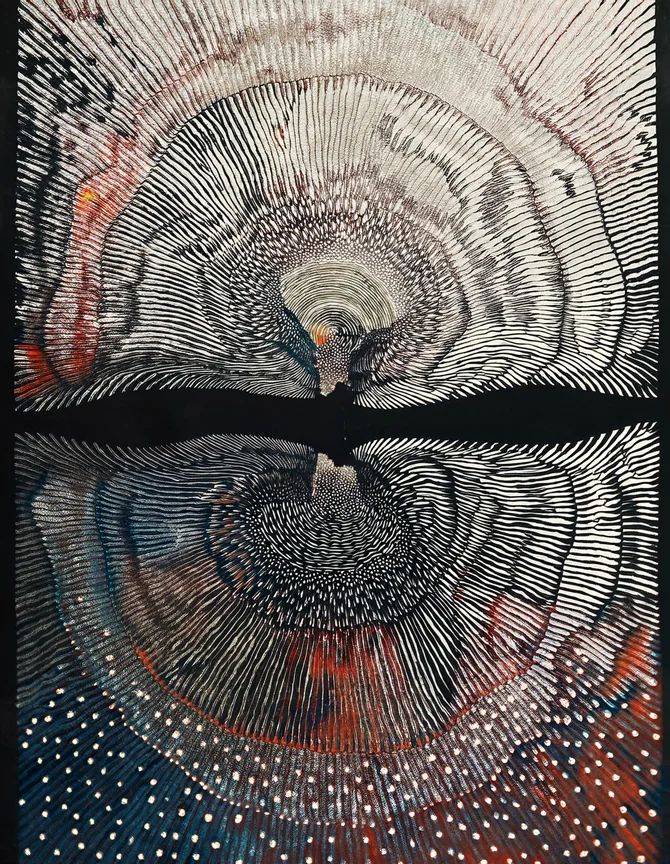
Hexagram 58 · 兌 Duì
The Open Exchange
Lake within · Lake without
This is a moment of openness, joy, and genuine exchange — connection freely given and received. The gift is real relationship, reciprocity, the gladness of true meeting. The hazard, present in the same openness, is that joy sought from outside becomes dependency, and openness with no boundary dissolves the self into the other. This is the situation of connection that must stay whole to stay joyful.
- Inner · Outer
- ☱ Lake · ☱ Lake
- Hands
- Love · Love
- Turned view
- 57 The Patient Entering
- Complement
- 52 The Held Boundary
- Nuclear
- 37 The Ordered House
This figure has thirteen parts. Six are always open here; one more opens each week.
About 650 of its 2800 words
- 01The Figure
- 02The ForcesIn the full figure
- 03The BodyIn the full figure
- 04The Situation
- 05The Interval
- 06The Family FieldIn the full figure
- 07The Facing FiguresIn the full figure
- 08Calibration
- 09The Arena Question
- 10Weather
- 11The Unhanding NoteIn the full figure
- 12The Six Lines
- 13Source NotesIn the full figure
04 · The Situation
The figure has no counterweight in it. There is no boundary to bank the openness, no stillness to hold it — only open joyous exchange, within and without.
05 · The Interval
The interval here is crossed by opening, not by effort. The gap between what is and what could be closes through connection — through the glad meeting of self and other — and the figure's method is simply to open. But its danger lives in the same move: openness without a self to open from is not connection but dissolution, and the interval cannot be crossed by a self that has disappeared into the other. The task is to open fully while remaining whole — to meet without merging, to give joy without seeking it back as a need.
08 · Calibration
Deficiency
the closed door
Disconnection, indifference, objectification, the inability to perceive others deeply. Treating people as functions, meeting no one, the lake gone stagnant and unreflecting.
Alignment
the whole meeting
Deep connection without loss of self; respect for both the unity and the distinctness of two people; the open exchange between selves who remain themselves — able to give joy freely and to let go freely, to connect without merging.
Excess
the dissolved self
Over-identification, loss of boundaries, enmeshment, emotional dependency; the seductive joy sought from outside (line 6), the openness that cannot bear separation, the self poured into the other until neither is whole. Joy become need.
Which way it tends. The figure turns on one distinction: connection between whole selves versus dissolution of the self into the other. Toward the closed door or the dissolved self: either no meeting happens at all, or the meeting consumes the self. Toward the whole meeting: two selves open to each other and remain themselves — the joy that is reciprocal because it is between distinct, whole people.
09 · The Arena Question
Who is truly here with me, and does this openness keep us both whole?
An arena can manufacture a false openness — a culture of enforced togetherness, a group that rewards dissolving into it, a relational field that punishes boundaries as coldness. Love misapplied opens indiscriminately, mistaking the arena's pull toward merger for genuine connection. Ask whether the openness is a meeting of whole selves, or a pressure to disappear into the group, the couple, the crowd.
10 · WeatherOpen this week
A part from the full figure, open to everyone this week. The same figure reads differently depending on the weather you cast it in.
Dark night
Love in the dark is the connection that sustains when little else does: the glad meeting that holds through the hard night. Precious. But watch the excess — in a dark night, the pull toward dissolving into another for comfort is strong, and comfort-merger is not the same as meeting. Open, but stay whole.
Bright day
open exchange in clear conditions is the straightforward joy of genuine relationship: connection that can be seen and trusted. The weather in which Love is most simply itself.
Mundane day
the daily, unremarkable exchange that constitutes most real relationship: the ordinary glad meetings that no one records and everything rests on. Love's quietest and most sustaining work.
12 · The Six Lines
One arc: contented joy, sincere joy, joy sought from outside, joy weighed, trust in what erodes, and joy that seduces. Each line, when it moves, carries the figure somewhere else.
Line 1becomes 47 The Exhaustion →
Contented joyousness. Good fortune.
The highest expression, and it comes first: joy that needs nothing from outside, contentment that is whole in itself and therefore able to meet others freely rather than from lack.
This is Love at its cleanest — the self full enough to open without needing to be filled. Good fortune, because a self that is already content can
The full reading of this line · about 110 words
Line 2becomes 17 The Following →
Sincere joyousness. Good fortune. Remorse disappears.
Joy grounded in sincerity: the glad exchange that is honest all the way down, and because it is true, remorse dissolves.
This is Love that does not perform or extract — it means what it offers. Sincerity is what makes the openness safe; the truthful meeting leaves no regret
The full reading of this line · about 90 words
Line 3becomes 43 The Resolute Breakthrough →
Coming joyousness. Misfortune.
This is the excess beginning: joy sought from outside oneself, reaching downward and outward to be filled rather than opening from fullness.
The "coming" joy is the joy of dependency — pleasure pursued because the self is empty, and it brings misfortune because it cannot satisfy and dissolves the seeker.
The full reading of this line · about 110 words
Line 4becomes 60 The Measure →
Joyousness that is weighed is not at peace. After ridding himself of mistakes, a man has joy.
Here the self is torn between a higher joy and a lower, and the weighing itself is restless — no peace while the choice is unmade.
The resolution is to rid oneself of the mistake, the lower pull, the dependency; and then the joy comes, clean. This is Love discriminating between the whole meeting
The full reading of this line · about 110 words
Line 5becomes 54 The Given Place →
Sincerity toward disintegrating influences is dangerous.
Even at the height of the hand, there is a danger: giving your sincere openness to what is disintegrating — trusting, with full heart, someone or something that erodes and dissolves.
The very sincerity that is Love's strength becomes a liability when aimed at what corrodes. The discipline of the realized position is discernment: open fully, but not toward
The full reading of this line · about 110 words
Line 6becomes 10 The Careful Treading →
Seductive joyousness.
The final form of the excess: seductive joyousness, pleasure that leads rather than meets, the openness that has become pure susceptibility to being drawn away from oneself.
The classical text gives no verdict here, and the omission is the reading — this is the edge where Love becomes its own undoing, and whether it is
The full reading of this line · about 130 words
Also in this figure
Where it lives in your body, who it moves with, and the trap it sets.

The Changes · Mikono Tisa
Sixty-four figures. Every part, every line, every painting.
730 pages · 64 original paintings · the Nine Hands mapped onto the eight trigrams · no verdicts, only trajectories.
The reading room
$5 / month
or $45 a year. The whole book online, every figure in full, 20% off readings.
Opening soon — join the letters to hear first.
The book
$50
The illustrated digital edition to keep, with three months of the reading room.
Opening soon — join the letters to hear first.
Want this figure read for your situation? Book a reading with Nathaniel