
Hexagram 47 · 困 Kùn
The Exhaustion
Water within · Lake without
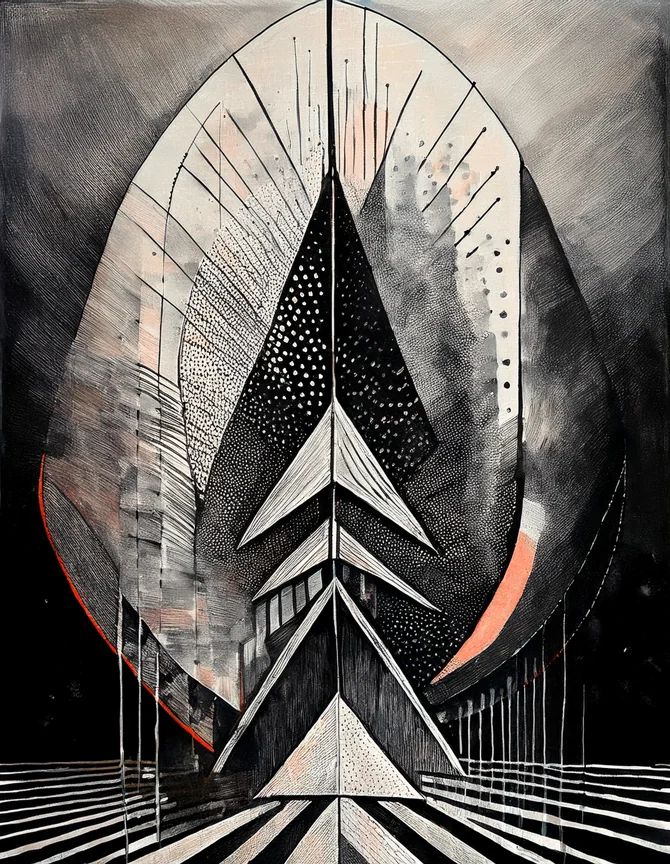
This is a time of exhaustion and constraint — oppression, being hemmed in, worn down, cut off from what sustains. The figure holds a hard hope: "oppression. Success. The great man brings about good fortune" — even here, the one who stays true can come through — but with a sharp realism: "when one has something to say, it is not believed," so in oppression, words fail and one must act rather than argue. The line texts trace the depths: oppressed under a bare tree, lost in a gloomy valley, seeing nothing for three years (line 1, the paralysis of despond); oppressed even amid plenty, but help is coming — stay put and make offerings (line 2); oppressed by immovable stone, leaning on thorns, coming home to not even see one's wife (line 3, self-inflicted desolation); coming slowly, hampered even in a golden carriage (line 4, oppression by one's own advantages); cut off from advance and retreat, yet joy coming softly (line 5, the deepest oppression turning); and oppressed by clinging vines, freed at last by a decisive move once one repents the hesitation (line 6). To bear oppression rightly is to stay true, act quietly, and wait for the soft turning.
- Inner · Outer
- ☵ Water · ☱ Lake
- Hands
- Tension · Love
- Turned view
- 48 The Constant Well
- Complement
- 22 The Quiet Grace
- Nuclear
- 37 The Ordered House
This figure has thirteen parts. Six are always open here; one more opens each week.
About 1100 of its 3400 words
- 01The Figure
- 02The ForcesIn the full figure
- 03The BodyIn the full figure
- 04The Situation
- 05The Interval
- 06The Family FieldIn the full figure
- 07The Facing FiguresIn the full figure
- 08Calibration
- 09The Arena Question
- 10Weather
- 11The Unhanding NoteIn the full figure
- 12The Six Lines
- 13Source NotesIn the full figure
05 · The Interval
The interval here is crossed by staying true through exhaustion — the gap between what is and what could be is bridged not by forcing one's way out (words are not believed, advance is cut off) but by holding one's inner center and integrity while hemmed in, acting quietly and reverently, and moving decisively when the entanglement can at last be broken (line 6). The task is the conduct of adversity: to bear being worn down without losing one's truth, to act rather than protest, and to wait for the joy that "comes softly." What crosses this interval is the integrity kept through depletion, and the soft turning toward relief.
08 · Calibration
Deficiency
the collapse into despond
Sinking under the oppression — the paralysis of one who sits under the bare tree and “sees nothing for three years” (line 1), losing one's inner center and truth to the weight of being worn down. Adversity that hollows out the person.
Alignment
the exhaustion borne true
Adversity held with kept integrity: staying inwardly true while confined, acting quietly and reverently (the offerings of lines 2, 5), not adding self-inflicted traps to circumstantial ones, and moving decisively when the vines can at last be broken (line 6).
Excess
the thrashing, and the self-
inflicted trap The exhausting protest — spending oneself on words that “are not believed” against a constraint force cannot move — and the self-inflicted oppression: leaning on thorns, trapped by stone of one's own choosing (line 3), adding bad choices to circumstance until it worsens.
Which way it tends. Toward the collapse or the thrashing: either one sinks into despond (collapse) or exhausts oneself on unbelieved protest and self-inflicted traps (thrashing). Toward the exhaustion borne true: one keeps the inner center, acts quietly and reverently, and waits for the soft turning — the integrity that carries through depletion to the joy that comes softly.
09 · The Arena Question
Where am I hemmed in and worn down here — and am I keeping my center and acting quietly and true, or collapsing into despond, or exhausting myself on protest and self-inflicted traps?
Where am I hemmed in and worn down here — and am I keeping my center and acting quietly and true, or collapsing into despond, or exhausting myself on protest and self-inflicted traps? Arenas have their times of exhaustion — being cut off, constrained, depleted, unheard. The figure's arena question is about the conduct of that adversity: are you keeping your inner truth and acting quietly, or sinking into despond, or thrashing against a constraint that force cannot move (and trapping yourself further)? The costly errors are the collapse and the exhausting protest. Ask whether you can hold your center while confined, act rather than argue where words are not believed, and wait for the soft turning without adding to your own oppression.
10 · WeatherOpen this week
A part from the full figure, open to everyone this week. The same figure reads differently depending on the weather you cast it in.
Dark night
oppression in a dark time is the figure's own weather: cut off, worn down, unheard, seeing nothing. The counsel — keep your inner truth even when you see nothing; act quietly and reverently, and trust that joy comes softly even in the dark. Watch the deficiency: the dark-night danger is the collapse into despond that abandons the center. Hold on.
Bright day
the constraint and the coming relief both clearly seen: the best weather for recognizing that "joy comes softly," for the decisive move (line 6) once the entanglement can be broken. The oppression is real but its turning is visible. Move when the vines give way.
Mundane day
the ordinary, grinding depletions of a life: the daily exhaustions and constraints that ask only to be borne true and quiet. The figure's true home — most oppression is undramatic wear, carried without collapse or thrashing.
12 · The Six Lines
One arc: oppression from the despond under the bare tree, through the oppression amid plenty, the self- inflicted trap, and the hampering advantages, to the deep oppression that turns softly and the vines broken by a decisive move. Read as the conduct of adversity — borne true, acted quietly, waited through. Each line, when it moves, carries the figure somewhere else.
Line 1becomes 58 The Open Exchange →
One sits oppressed under a bare tree and strays into a gloomy valley. For three years one sees nothing.
At the bottom, the deepest despond: one "sits oppressed under a bare tree" — a tree that gives no shelter — and "strays into a gloomy valley," and "for three years one sees nothing." Oppression here is not just circumstance but the paralysis it induces: the loss of all light and prospect, a long blindness of the spirit.
The counsel: do not let oppression sink you into the despond that sees nothing — the bare tree, the gloomy valley, the long blindness; circumstance need not become
The full reading of this line · about 140 words
Line 2becomes 45 The Gathering →
One is oppressed while at meat and drink. The man with the scarlet knee bands is just coming. It furthers one to offer sacrifice. To set forth brings misfortune. No blame.
A subtler oppression: one is "oppressed while at meat and drink" — hemmed in even amid apparent plenty, a constraint that wealth does not relieve.
But help is on the way ("the man with the scarlet knee bands is just coming" — the prince, the ally). The counsel: make offerings, stay reverent and
The full reading of this line · about 160 words
Line 3becomes 28 The Overloaded Beam →
A man permits himself to be oppressed by stone, and leans on thorns and thistles. He enters his house and does not see his wife. Misfortune.
The figure's warning against self-worsened oppression: a man "permits himself to be oppressed by stone" — trapped against the immovable by his own choices — and "leans on thorns and thistles," resting on what wounds him.
So trapped and self-wounding, "he enters his house and does not see his wife" — a desolation so complete he cannot find even what is nearest and dearest.
The full reading of this line · about 150 words
Line 4becomes 29 The Load You Do Not Put Down →
He comes very quietly, oppressed in a golden carriage. Humiliation, but the end is reached.
A peculiar oppression: one "comes very quietly, oppressed in a golden carriage" — hampered and slowed by one's own wealth and position (the golden carriage that should ease the way instead impedes it).
There is humiliation in being so encumbered by one's advantages, in coming slow and constrained where one should come free — "but the end is reached." Even oppression-by-privilege
The full reading of this line · about 140 words
Line 5becomes 40 The Release →
His nose and feet are cut off. Oppression at the hands of the man with the purple knee bands. Joy comes softly. It furthers one to make offerings and libations.
The figure's depth and its turning, at its ruling seat: "his nose and feet are cut off" — cut off from both advance and retreat, wounded in the severest way — and the oppression comes even "at the hands of the man with the purple knee bands," from the very quarter (high office, those who should help) that ought to have relieved it.
And yet: "joy comes softly." At the very bottom, relief begins — gradual, quiet, not yet full, but real — and the counsel is to "make offerings and
The full reading of this line · about 180 words
Line 6becomes 6 The Halted Conflict →
He is oppressed by creeping vines. He moves uncertainly and says, "Movement brings remorse." If one feels remorse over this and makes a start, good fortune comes.
At the summit, oppression is nearly over: one is "oppressed by creeping vines" — tangling growth that can, unlike stone, be broken through — but one hesitates, "moves uncertainly," and says, "movement brings remorse," afraid that acting will only make things worse.
The turning is this: "if one feels remorse over this" — over the very hesitation, the paralysis of fear — "and makes a start, good fortune comes." At
The full reading of this line · about 190 words
Also in this figure
Where it lives in your body, who it moves with, and the trap it sets.

The Changes · Mikono Tisa
Sixty-four figures. Every part, every line, every painting.
730 pages · 64 original paintings · the Nine Hands mapped onto the eight trigrams · no verdicts, only trajectories.
The reading room
$5 / month
or $45 a year. The whole book online, every figure in full, 20% off readings.
Opening soon — join the letters to hear first.
The book
$50
The illustrated digital edition to keep, with three months of the reading room.
Opening soon — join the letters to hear first.
Want this figure read for your situation? Book a reading with Nathaniel