
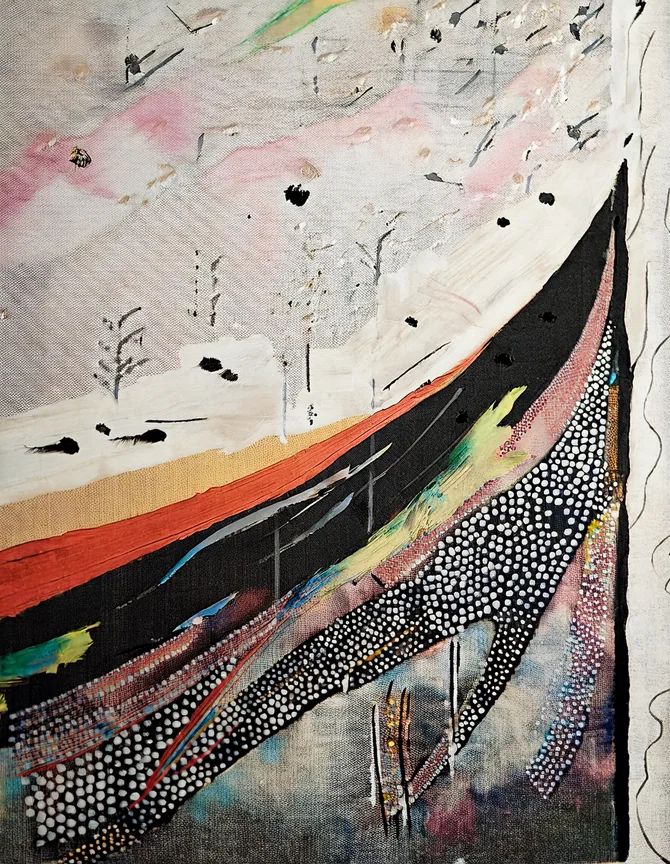
Hexagram 22 · 賁 Bì
The Quiet Grace
Fire within · Mountain without
This is a matter of grace and form — adornment, beauty, the fitting shape given to things. The figure is favorable but bounded: "grace. Success. In small matters it is favorable to undertake something" — grace succeeds, but in small and secondary matters; form is good, but it is not the foundation, and it must not outrun the substance it adorns. The line texts trace a movement from ornament toward simplicity: gracing one's toes, choosing to walk on one's own feet rather than ride an unearned carriage (line 1, modest self-reliance); grace as mere ornament that only follows substance, like a beard moving with the chin (line 2, the caution); graced and glistening, needing perseverance not to sink into luxury (line 3); the choice between adornment and simplicity, the plain white horse coming in sincerity (line 4); the meager, modest grace of a simple hermitage, humiliating in its poverty of show but fortunate in the end (line 5); and, at the summit, "simple grace, no blame" (line 6) — form perfected into plainness. Grace is good, but its perfection is simplicity.
- Inner · Outer
- ☲ Fire · ☶ Mountain
- Hands
- Attention · Inner Sovereignty
- Turned view
- 21 The Biting Through
- Complement
- 47 The Exhaustion
- Nuclear
- 40 The Release
This figure has thirteen parts. Six are always open here; one more opens each week.
About 900 of its 3100 words
- 01The Figure
- 02The ForcesIn the full figure
- 03The BodyIn the full figure
- 04The Situation
- 05The Interval
- 06The Family FieldIn the full figure
- 07The Facing FiguresIn the full figure
- 08Calibration
- 09The Arena Question
- 10Weather
- 11The Unhanding NoteIn the full figure
- 12The Six Lines
- 13Source NotesIn the full figure
05 · The Interval
The interval here is crossed by fitting form that resolves toward simplicity — the gap between what is and what could be is bridged by giving things their right, quiet shape, and by letting that grace reduce, in the end, to the plainness that is its highest form. The task is grace kept in its place: form fitted to substance and never outrunning it, adornment chosen over luxury, and the whole movement bent toward the simple grace that needs no ornament. What crosses this interval is the still, fitting form — perfected, at last, into simplicity.
08 · Calibration
Deficiency
the graceless, or the merely-
followed form Substance given no fitting form at all — the shapeless presentation that fails to honor what it carries — or grace reduced to mere ornament with no substance of its own, like the beard that only moves with the chin (line 2), decoration that follows but adds nothing.
Alignment
the quiet grace
Fitting form kept in its place and resolving toward simplicity: the modest self-reliance that walks on its own feet (line 1), the sincerity of the plain white horse chosen over ornament (line 4), and above all “simple grace” (line 6) — form perfected into plainness.
Excess
the ornament that outruns
substance Form that overruns or replaces the substance it should serve — adornment become luxury, display for its own sake, the graced-and-glistening state that sinks into mere luxuriance if not persevered against (line 3). Grace inflated past its place.
Which way it tends. Toward the graceless or the over-adorned: either substance is given no fitting form or form outruns and replaces substance (luxury, mere ornament). Toward the quiet grace: form is fitted to substance and let to reduce toward the simplicity that is its highest state — culminating in simple grace, no blame.
09 · The Arena Question
The figure's arena question is about the relation of form to substance: are you giving things What am I giving form to here — and is the grace fitting and resolving toward simplicity, or graceless, or ornament that outruns the substance?
Arenas ask for presentation, form, adornment. The figure's arena question is about the relation of form to substance: are you giving things What am I giving form to here — and is the grace fitting and resolving toward simplicity, or graceless, or ornament that outruns the substance? their right, quiet form and letting it reduce toward simplicity, or leaving substance graceless, or piling on ornament that outruns what it decorates? The costly error is the adornment that replaces substance. Ask whether your form serves its substance, whether it could reduce to something simpler and be the better for it, and whether you are chasing display or fitting shape.
10 · WeatherOpen this week
A part from the full figure, open to everyone this week. The same figure reads differently depending on the weather you cast it in.
Dark night
grace in a dark time bends naturally toward simplicity: display is out of place, and the plain, fitting form is what serves. The counsel — reduce to simple grace; the dark-night beauty is the unadorned, sincere form. Watch the deficiency: do not let hard times make you graceless, only simpler.
Bright day
form and substance both clearly seen: the best weather for grace fitted rightly, and for seeing where ornament has outrun its substance. The danger is the bright-day temptation to display (line 3's glistening luxury). Fit the form, and prefer simplicity.
Mundane day
the ordinary, daily giving of form: the unremarkable, fitting shape given to the small matters of a life. The figure's true home — most grace is quiet, small, and simply makes things fitting.
12 · The Six Lines
One arc: grace from the graced toes that walk, through the beard that only follows, the glistening luxury, the plain white horse, and the meager hermitage, to the simple grace that is form's summit. Read as fitting form resolving toward simplicity. Each line, when it moves, carries the figure somewhere else.
Line 1becomes 52 The Held Boundary →
He lends grace to his toes, leaves the carriage, and walks.
At the start, one "lends grace to his toes" — graces the lowest, humblest part — and "leaves the carriage, and walks": refuses an unearned conveyance, choosing to go modestly on his own feet rather than ride in a splendor he has not earned.
Grace here is integrity and self-reliance in small beginnings, not borrowed show. The counsel: grace the humble and go on your own feet — refuse the unearned splendor,
The full reading of this line · about 130 words
Line 2becomes 26 The Great Restraint →
Lends grace to the beard on his chin.
At the center, one "lends grace to the beard on his chin" — and the beard is the figure's caution: it has no motion of its own, it only moves when the chin (the substance) moves.
This is grace that is mere ornament — decoration with no independent substance, adding nothing but following what is already there. A warning at the very center: form
The full reading of this line · about 140 words
Line 3becomes 27 The Open Mouth →
Graceful and moist. Constant perseverance brings good fortune.
Here one is "graceful and moist" — adorned and glistening, in a comfortable, favored, well-appointed state, ease and beauty together.
It is pleasant, but it carries a danger: such a graced-and-glistening state can sink into mere luxury and softness. So "constant perseverance brings good fortune" — one must
The full reading of this line · about 130 words
Line 4becomes 30 The Clinging Light →
Grace or simplicity? A white horse comes as if on wings. He is not a robber; he will woo at the right time.
A moment of decision between ornament and plainness: "grace or simplicity?" And the answer comes swiftly — "a white horse comes as if on wings," the white (plain, unadorned) horse arriving in haste.
The one who comes so plainly "is not a robber" — his simplicity is not a threat but sincerity — and "he will woo at the right time":
The full reading of this line · about 150 words
Line 5becomes 37 The Ordered House →
Grace in the hills and gardens. The roll of silk is meager and small. Humiliation, but in the end good fortune.
"Grace in the hills and gardens" — the simple beauty of a modest hermitage, a retreat among hills and gardens rather than palaces.
Here "the roll of silk is meager and small": the gift, the outward show, is poor and scanty. There is "humiliation" in the poverty of display — one
The full reading of this line · about 160 words
Line 6becomes 36 The Hidden Light →
Simple grace. No blame.
At the summit, the figure's whole movement arrives: "simple grace.
No blame." Grace has been reduced to its purest form — plain, white, unornamented — and this simplicity is the highest grace, form perfected by having everything unnecessary
The full reading of this line · about 140 words
Also in this figure
Where it lives in your body, who it moves with, and the trap it sets.

The Changes · Mikono Tisa
Sixty-four figures. Every part, every line, every painting.
730 pages · 64 original paintings · the Nine Hands mapped onto the eight trigrams · no verdicts, only trajectories.
The reading room
$5 / month
or $45 a year. The whole book online, every figure in full, 20% off readings.
Opening soon — join the letters to hear first.
The book
$50
The illustrated digital edition to keep, with three months of the reading room.
Opening soon — join the letters to hear first.
Want this figure read for your situation? Book a reading with Nathaniel