
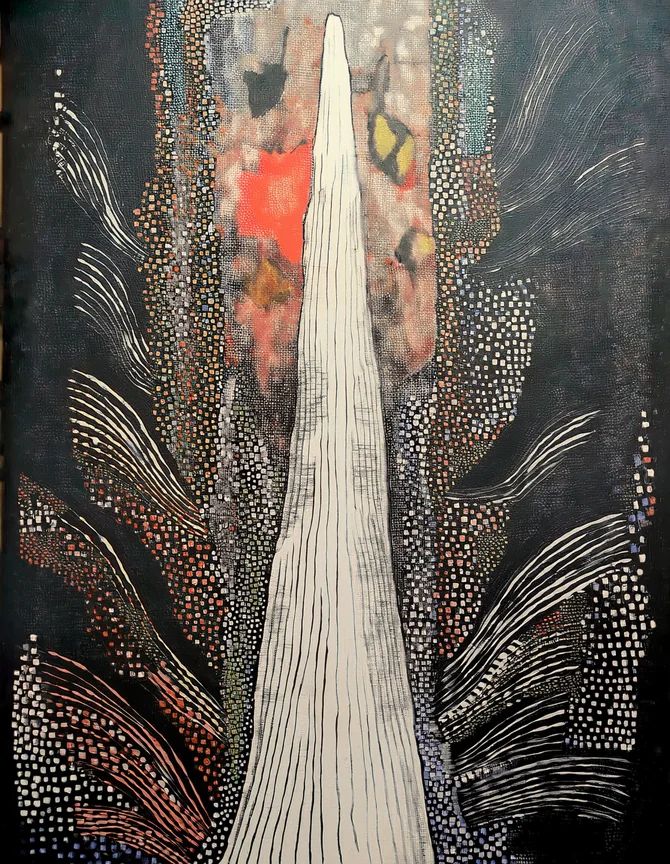
Hexagram 26 · 大畜 Dà Xù
The Great Restraint
Heaven within · Mountain without
This is great power held in reserve — the taming and accumulating of vast creative force, the discipline that builds up great capacity and holds it until the right time. The figure is favorable and outward-turned: "perseverance furthers; not eating at home brings good fortune; it furthers one to cross the great water" — the accumulated power is for public use and great undertakings, not private hoarding. The line texts trace the arc of holding and releasing: danger at the start, better to desist than push against the great restraint (line 1); removing one's own axletrees, willing self-restraint (line 2); the good horse now galloping with others, the force beginning to move, disciplined by daily practice (line 3); the young bull's headboard, restraint applied early and gently before the danger grows (line 4, great good fortune); the gelded boar's tusk, the danger transformed at its source (line 5); and at last "the way of heaven" — the accumulated force released into free creative action (line 6). Great restraint is not permanent suppression; it is the disciplined accumulation of power toward its right release.
- Inner · Outer
- ☰ Heaven · ☶ Mountain
- Hands
- Evolution · Inner Sovereignty
- Turned view
- 25 The Innocence
- Complement
- 45 The Gathering
- Nuclear
- 54 The Given Place
This figure has thirteen parts. Six are always open here; one more opens each week.
About 900 of its 3100 words
- 01The Figure
- 02The ForcesIn the full figure
- 03The BodyIn the full figure
- 04The Situation
- 05The Interval
- 06The Family FieldIn the full figure
- 07The Facing FiguresIn the full figure
- 08Calibration
- 09The Arena Question
- 10Weather
- 11The Unhanding NoteIn the full figure
- 12The Six Lines
- 13Source NotesIn the full figure
05 · The Interval
The interval here is crossed by accumulating great power and rightly releasing it — the gap between what is and what could be is bridged not by spending force as it arises but by holding and cultivating it, building a great reserve, and releasing it along the way of heaven when the time and the transformation are right. The task is disciplined accumulation: to restrain the force early and gently, to transform danger at its source rather than fight it head-on, to keep training while holding, and to put the accumulated power to public use. What crosses this interval is the great reserve, cultivated and rightly released.
08 · Calibration
Deficiency
the dissipated force
Failing to accumulate — spending the creative force as fast as it arises, never building the reserve, so no great capacity is ever developed. Power scattered instead of held.
Alignment
the great restraint
Great force accumulated, cultivated, transformed, and rightly released: restrained early and gently (line 4), its danger transformed at the source (line 5, the gelded boar), trained while held (line 3), put to public use, and released along the way of heaven when the time is right (line 6).
Excess
the dammed force, never
released Restraint become mere blockage — the great power held and held until it is only suppressed, never transformed, never released along the way of heaven. Accumulation turned to a dam with no outlet, force hoarded against the figure's own “not eating at home.”
Which way it tends. Toward the dissipated or the dammed: either the force is spent as it arises (no reserve) or held without ever transforming or releasing (suppressed). Toward the great restraint: the force is accumulated, transformed at its source, kept in trained reserve, and released along the way of heaven when the time is right — the cultivated reserve rightly spent.
09 · The Arena Question
What great force am I holding here — and am I accumulating and cultivating it toward a right release, or dissipating it as it arises, or damming it without ever letting it move?
What great force am I holding here — and am I accumulating and cultivating it toward a right release, or dissipating it as it arises, or damming it without ever letting it move? Arenas concentrate power — force that can be spent as it arises or built into a reserve. The figure's arena question is about the discipline of accumulation: are you holding and cultivating your great force toward its right use, transforming its danger at the source, and releasing it rightly — or spending it prematurely, or damming it into mere suppression? The costly errors are the dissipation and the dam without an outlet. Ask whether you are building a reserve or scattering your force, whether you are transforming danger or merely fighting it, and whether the accumulated power is aimed at public use.
10 · WeatherOpen this week
A part from the full figure, open to everyone this week. The same figure reads differently depending on the weather you cast it in.
Dark night
great restraint in a dark time is where the reserve most matters: force held and cultivated through the dark, not spent in the poor light, is what remains to be released when day returns. The counsel — accumulate and hold through the dark; do not dissipate your power in a time when it cannot be rightly used. Watch the excess: do not let the long holding become a permanent dam.
Bright day
the force and its right release both clearly seen: the best weather for the transformation at the source (line 5) and the release along the way of heaven (line 6). The reserve, built in reserve, is spent rightly here. Release the accumulated power when the day is clear.
Mundane day
the ordinary, daily discipline of holding and cultivating force: the unremarkable accumulation of capacity — training, saving, building — that most great reserves are made of. The figure's true home — most great restraint is quiet, patient accumulation toward a use not yet arrived.
12 · The Six Lines
One arc: great restraint from the danger that counsels desisting, through the self-removed axletrees, the good horse now running, the young bull's headboard, and the gelded boar's tusk, to the release along the way of heaven. Read as the disciplined accumulation of great force toward its right release. Each line, when it moves, carries the figure somewhere else.
Line 1becomes 18 The Repairing →
Danger is at hand. It furthers one to desist.
At the start, meeting the great restraining force, "danger is at hand" — to push forward now against so great a containment is perilous — and so "it furthers one to desist." The first response to great restraint is to stop, to accept the holding rather than force through it.
The counsel: when a great restraint meets you at the start, do not push against it — desist; the danger is in forcing forward, and the strength is
The full reading of this line · about 120 words
Line 2becomes 22 The Quiet Grace →
The axletrees are taken from the wagon.
At the center, one "takes the axletrees from the wagon" — removes one's own means of forward motion, immobilizing oneself willingly.
Rather than being forced to halt, one accepts the restraint from within, holding back one's own force by choice. Self-restraint freely undertaken is stronger than restraint imposed. The
The full reading of this line · about 110 words
Line 3becomes 41 The Diminishing →
A good horse that follows others. Awareness of danger, with perseverance, furthers. Practice chariot driving and armed defense daily.
Now the restraint eases and the force begins to move: "a good horse that follows others" — the accumulated energy released into motion, galloping alongside its fellows.
But the counsel keeps it disciplined: stay "aware of danger," persevere, and "practice chariot driving and armed defense daily" — keep training even as the force runs, so
The full reading of this line · about 130 words
Line 4becomes 14 The Bright Abundance →
The headboard of a young bull. Great good fortune.
The figure's counsel of early prevention: "the headboard of a young bull" — a board fixed to the horns of a young bull, before the horns have grown dangerous, so the animal is gently checked before it can do harm.
Restraint applied early, while the force is still young and manageable, prevents the great trouble a grown force would bring. Great good fortune. The counsel: restrain the growing
The full reading of this line · about 130 words
Line 5becomes 9 The Small Restraint →
The tusk of a gelded boar. Good fortune.
The figure's masterstroke, at its ruling seat: "the tusk of a gelded boar." A wild boar's tusk is dangerous — but a gelded boar keeps its tusk while losing the ferocity that made it dangerous.
The great force is not fought head-on nor stripped away; its danger is transformed at the source, so the power remains but the threat is gone. Good fortune.
The full reading of this line · about 150 words
Line 6becomes 11 The Great Peace →
One attains the way of heaven. Success.
At the summit, the accumulation is complete and the great force is released: "one attains the way of heaven.
Success." All the holding, cultivating, and transforming has built a reserve that now flows out freely along the way of heaven — the vast creative power, so long
The full reading of this line · about 150 words
Also in this figure
Where it lives in your body, who it moves with, and the trap it sets.

The Changes · Mikono Tisa
Sixty-four figures. Every part, every line, every painting.
730 pages · 64 original paintings · the Nine Hands mapped onto the eight trigrams · no verdicts, only trajectories.
The reading room
$5 / month
or $45 a year. The whole book online, every figure in full, 20% off readings.
Opening soon — join the letters to hear first.
The book
$50
The illustrated digital edition to keep, with three months of the reading room.
Opening soon — join the letters to hear first.
Want this figure read for your situation? Book a reading with Nathaniel