
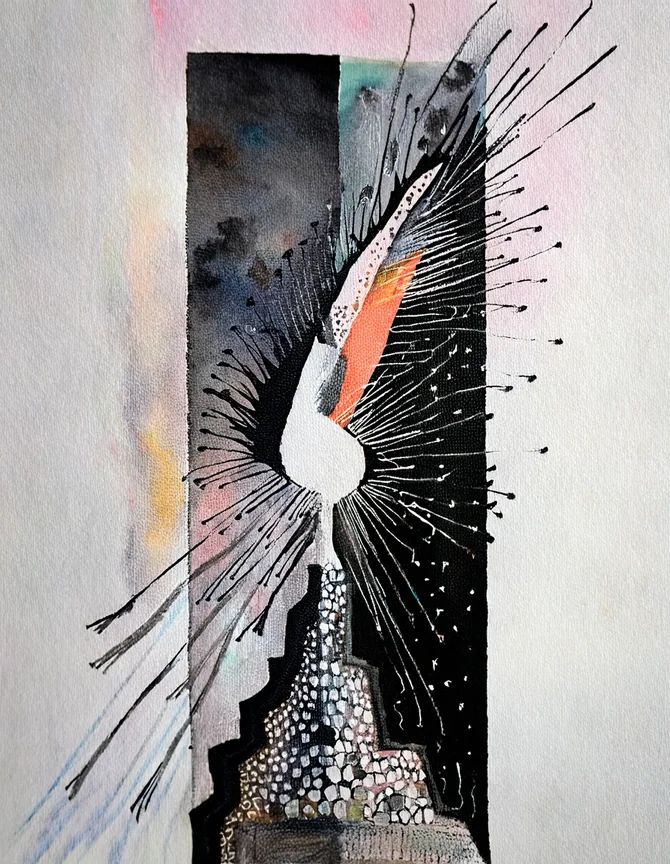
Hexagram 27 · 頤 Yí
The Open Mouth
Thunder within · Mountain without
This is a moment about nourishment — seeking it, providing it, and discerning its quality. What sustains you, and what you sustain in others, is the question. It concerns everything that crosses the threshold of the mouth in both directions: what you take in to be nourished, and what you give out to nourish. The situation asks you to attend to the sources and the provision of sustenance — your own and others'.
- Inner · Outer
- ☳ Thunder · ☶ Mountain
- Hands
- Courage · Inner Sovereignty
- Turned view
- Itself
- Complement
- 28 The Overloaded Beam
- Nuclear
- 2 The Whole Yielding
This figure has thirteen parts. Six are always open here; one more opens each week.
About 700 of its 2800 words
- 01The Figure
- 02The ForcesIn the full figure
- 03The BodyIn the full figure
- 04The Situation
- 05The Interval
- 06The Family FieldIn the full figure
- 07The Facing FiguresIn the full figure
- 08Calibration
- 09The Arena Question
- 10Weather
- 11The Unhanding NoteIn the full figure
- 12The Six Lines
- 13Source NotesIn the full figure
05 · The Interval
The interval here is crossed by right intake and right provision. The gap between what is and what could be closes through nourishment properly sought and rightly given — and it fails to close, or reopens as depletion, when nourishment is sought from the wrong source or given for the wrong reason. The task is to fill the hollow rightly: to receive what genuinely nourishes and to provide what genuinely sustains, rather than filling the mouth with what depletes.
08 · Calibration
Deficiency
the wrong or absent
nourishment Feeding on what depletes — bad food, bad media, bad company, corrosive words — or failing to nourish self or others at all; abandoning your own genuine inner resource to envy someone else's (line 1). The mouth filled with what does not sustain.
Alignment
right nourishment, rightly
sourced and rightly given Discerning what genuinely sustains and taking that in; providing what genuinely nourishes others without overfeeding; drawing sustenance from proper sources for proper purposes; and, at the height, becoming a clean source of nourishment for others.
Excess
the greedy or over-provided
intake Insatiable craving, over-consumption, the tiger's sharp-eyed appetite that must be disciplined (line 4) — or over-provision, force-feeding, nourishing others past what sustains them into what smothers. Too much crossing the threshold in either direction.
Which way it tends. Toward wrong or greedy nourishment: what crosses the mouth depletes rather than sustains — the intake poisons or the provision smothers. Toward right nourishment: sources and provision are discerned and stewarded, the receptive hollow filled with what feeds, and one becomes able to feed others.
09 · The Arena Question
What is nourishing whom here — and is any of it actually sustenance?
Arenas provide nourishment of every kind — information, culture, belonging, sustenance — and much of it depletes while claiming to feed. The figure's arena question is dietary in the widest sense: what is this place feeding you, what are you feeding it, and is the exchange nourishing or depleting? Watch especially for the arena that overfeeds you belonging in exchange for your discernment.
10 · WeatherOpen this week
A part from the full figure, open to everyone this week. The same figure reads differently depending on the weather you cast it in.
Dark night
nourishment in a dark time is the discipline of feeding yourself well when nothing external sustains: guarding your own inner resource (line 1's magic tortoise) rather than envying others' apparent plenty. Feed yourself what genuinely sustains, even in scarcity.
Bright day
clear conditions for right provision: you can see the sources and the needs plainly, and provide well. The danger is the greedy excess — plenty inviting over-consumption. Take and give what nourishes; do not gorge.
Mundane day
the daily, unremarkable diet of intake and output that constitutes most of a life: the ordinary meals, the ordinary words, the steady nourishment or steady depletion that accumulates unnoticed. This is where the figure does its real work — in what you habitually feed yourself and others.
12 · The Six Lines
One arc: nourishment sought and provided, from the envious abandonment of one's own resource to becoming the source for all. Read as a graded lesson in where sustenance rightly comes from. Each line, when it moves, carries the figure somewhere else.
Line 1becomes 23 The Stripping →
You let your magic tortoise go, and look at me with the corners of your mouth drooping. Misfortune.
You have your own magic tortoise — an inner resource that genuinely sustains you, that needs nothing external — and you let it go to gaze enviously at someone else's nourishment, mouth drooping with longing.
The misfortune is entirely self-inflicted: abandoning real self-sufficiency for envy. The correction is to turn back to your own tortoise. What sustains you is already yours.
The full reading of this line · about 90 words
Line 2becomes 41 The Diminishing →
Turning to the summit for nourishment, deviating from the path to seek nourishment from the hill. Continuing brings misfortune.
You turn upward and outward for sustenance — to the summit, the hill — deviating from your own proper path to seek nourishment from a higher source improperly.
To persist in this dependence brings misfortune. Even from a central position, seeking your sustenance from the wrong place, in the wrong way, depletes you. Find nourishment on
The full reading of this line · about 80 words
Line 3becomes 22 The Quiet Grace →
Turning away from nourishment. Perseverance brings misfortune. Do not act thus for ten years. Nothing furthers.
This is nourishment at its most corrupted: turning away from what genuinely sustains toward what actively harms — perverse feeding, the intake that poisons.
The warning is unusually severe: do not do this for ten years, nothing furthers. When the intake has become actively self-harming, the only medicine is a long and
The full reading of this line · about 90 words
Line 4becomes 21 The Biting Through →
Turning to the summit for provision of nourishment brings good fortune. Spying about with sharp eyes like a tiger, with insatiable craving. No blame.
Again you turn to the summit — but now for provision, to nourish others, not merely to feed yourself, and now it brings good fortune.
The tiger's sharp eyes and insatiable craving are permitted here, no blame, because the hunger is in service of feeding those who depend on you. The difference between
The full reading of this line · about 120 words
Line 5becomes 42 The Enriching →
Deviating from the path. To remain persevering brings good fortune. One should not cross the great water.
You depend on a stronger source for your nourishment — you deviate from independent provision — and this is acceptable if held steadily: persevere in the dependence rather than overreaching.
But do not undertake great things (do not cross the great water) while you are still being sustained by another; you are not yet a source, only a
The full reading of this line · about 90 words
Line 6becomes 24 The Turning →
The source of nourishment. Awareness of danger brings good fortune. It furthers one to cross the great water.
Now you are the source of nourishment for others — the well others draw from, the one who feeds.
This is the highest form of the figure and its greatest responsibility. Awareness of the danger it carries (the burden of being depended upon, the risk of depletion)
The full reading of this line · about 120 words
Also in this figure
Where it lives in your body, who it moves with, and the trap it sets.

The Changes · Mikono Tisa
Sixty-four figures. Every part, every line, every painting.
730 pages · 64 original paintings · the Nine Hands mapped onto the eight trigrams · no verdicts, only trajectories.
The reading room
$5 / month
or $45 a year. The whole book online, every figure in full, 20% off readings.
Opening soon — join the letters to hear first.
The book
$50
The illustrated digital edition to keep, with three months of the reading room.
Opening soon — join the letters to hear first.
Want this figure read for your situation? Book a reading with Nathaniel