
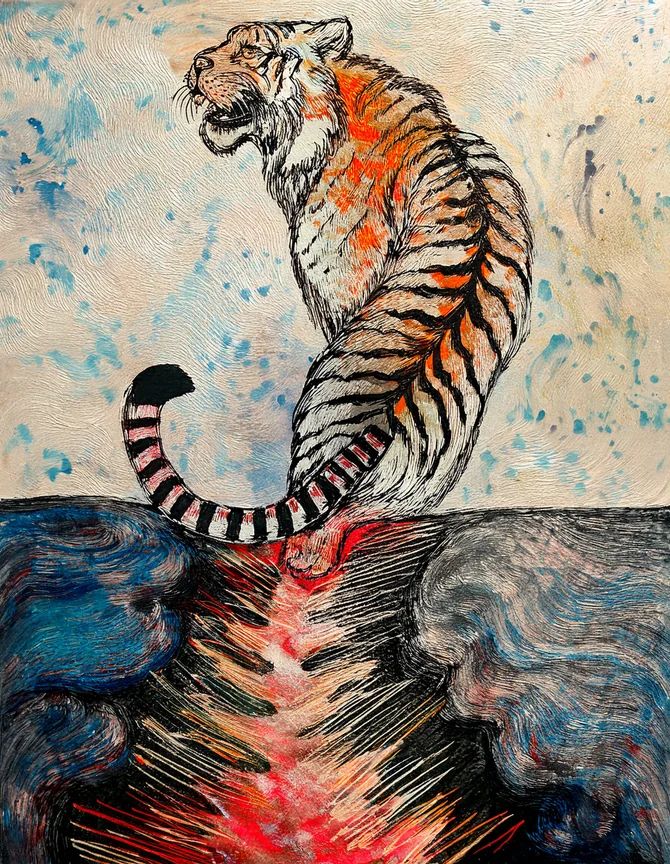
Hexagram 10 · 履 Lǚ
The Careful Treading
Lake within · Heaven without
This is conduct on dangerous ground — treading, comportment in a delicate or perilous situation, imaged as walking right on the tail of a tiger. The astonishing thing is that "it does not bite the man": right, careful conduct can proceed even in real danger unharmed. The line texts grade the treading: simple, plain conduct progresses without blame (line 1); the quiet, solitary person treads a smooth level path (line 2); but the one who overreaches his real capacity — the one-eyed man acting as if he saw whole, the lame man as if he walked whole — treads on the tiger and is bitten (line 3, misfortune); treading in real danger with great caution and circumspection ends in good fortune (line 4); resolute conduct taken with full awareness of danger (line 5, the ideal); and conduct judged at the end by its whole course — if complete and right, supreme good fortune (line 6). To tread well is to match one's step exactly to one's real footing.
- Inner · Outer
- ☱ Lake · ☰ Heaven
- Hands
- Love · Evolution
- Turned view
- 9 The Small Restraint
- Complement
- 15 The Humble Mountain
- Nuclear
- 37 The Ordered House
This figure has thirteen parts. Six are always open here; one more opens each week.
About 850 of its 3000 words
- 01The Figure
- 02The ForcesIn the full figure
- 03The BodyIn the full figure
- 04The Situation
- 05The Interval
- 06The Family FieldIn the full figure
- 07The Facing FiguresIn the full figure
- 08Calibration
- 09The Arena Question
- 10Weather
- 11The Unhanding NoteIn the full figure
- 12The Six Lines
- 13Source NotesIn the full figure
05 · The Interval
The interval here is crossed by careful conduct — the gap between what is and what could be is bridged by how one steps: treading the dangerous ground with care, matching one's stride to one's true capacity, proceeding cheerfully but with full awareness of the tiger one walks behind. The task is right comportment: simple and plain where that suffices, cautious and circumspect where the danger is real, resolute where resolve is called for — but never overreaching one's actual footing. What crosses this interval is the careful step, not the reckless stride.
08 · Calibration
Deficiency
the timid non-step
Failing to tread at all — the timidity that cannot proceed on dangerous ground, freezing rather than taking the careful step. Conduct paralyzed by the danger it should walk through.
Alignment
the careful treading
Conduct matched exactly to one's real footing: simple and plain where that suffices, cautious and circumspect in real danger, resolute with full awareness of the danger. The careful, good-humored step that walks even behind the tiger and is not bitten.
Excess
the overreaching stride
Treading beyond one's real capacity — the one-eyed man acting as if he saw whole, the lame man as if he walked whole (line 3), the reckless stride that treads on the tiger and is bitten. Conduct overreaching its true footing.
Which way it tends. Toward the timid or the overreaching: either one freezes before the danger (timidity) or oversteps one's real capacity and is bitten (the overreach). Toward the careful treading: one matches each step to one's true footing, cautious where danger is real and resolute with open eyes — the conduct that passes even danger unharmed.
09 · The Arena Question
What dangerous ground am I treading here — and am I matching my step to my real footing, or overreaching my true capacity (or freezing before the danger)?
Arenas put us on delicate ground, walking behind powers greater than ourselves. The figure's arena question is about the match between step and footing: are you treading carefully, within your real capacity, matching your conduct to the actual danger — or overreaching like the lame man who strides as if whole, or freezing before the tiger? The costly error is the overreach that courts the bite. Ask whether your step matches your true footing, and whether you are proceeding with full, open-eyed awareness of the danger.
10 · WeatherOpen this week
A part from the full figure, open to everyone this week. The same figure reads differently depending on the weather you cast it in.
Dark night
treading in a dark time is where overreach is most dangerous: unable to see the ground, one may stride beyond one's footing without knowing. The counsel — tread simply and cautiously in the dark, feeling for your true footing rather than striding; the dark-night failure is the blind overreach. Match your step to what you can actually feel beneath you.
Bright day
the ground and the danger both clearly seen: the best weather for resolute conduct (line 5), the firm step taken with full awareness. The danger is smallest here; bright-day treading can be both careful and decisive. Step firmly, with open eyes.
Mundane day
the ordinary conduct of daily life: the unremarkable, careful stepping through the small delicacies and dangers of one's relations and work. The figure's true home — most conduct is quiet, careful, and simply matched to the moment.
12 · The Six Lines
One arc: treading from simple conduct and the level path, through the overreach that is bitten and the circumspect step through danger, to resolute conduct and the conduct judged by its whole. Read as the careful matching of one's step to one's real footing. Each line, when it moves, carries the figure somewhere else.
Line 1becomes 6 The Halted Conflict →
Simple conduct. Progress without blame.
At the start, "simple conduct" — plain, unadorned, modest treading, proceeding without pretension.
Progress without blame. The right first step on any ground is the simple one, matched to where you actually are. The counsel: begin with simple, unadorned conduct —
The full reading of this line · about 100 words
Line 2becomes 25 The Innocence →
Treading a smooth, level path. The conduct of a quiet, solitary man is blameless.
At the center, "treading a smooth, level path" — the calm, steady conduct of a "quiet, solitary man," one who keeps to himself and walks an even course without seeking the fray.
Blameless. Not every conduct must be dramatic; the quiet even tread of the retiring person is entirely right. The counsel: the calm, even conduct of one who keeps
The full reading of this line · about 120 words
Line 3becomes 1 The Undivided Ascent →
A one-eyed man is able to see, a lame man is able to tread. He treads on the tail of the tiger. The tiger bites the man. Misfortune. Thus does a warrior act on behalf of his great prince.
The figure's one clear failure: the "one-eyed man" acts as if he saw whole, the "lame man" as if he walked whole — overreaching a real limitation, pretending to a capacity one does not have.
So overreaching, "he treads on the tail of the tiger; the tiger bites the man. Misfortune." The line names the exception (a warrior may so overreach on behalf
The full reading of this line · about 170 words
Line 4becomes 61 The Open Heart →
He treads on the tail of the tiger. Caution and circumspection lead ultimately to good fortune.
Here one genuinely "treads on the tail of the tiger" — in real, close danger — but with "caution and circumspection," and this leads ultimately to good fortune.
Where line 3 overreached and was bitten, line 4 treads the same tiger's tail but with such wariness and care that it passes safely. The danger is real;
The full reading of this line · about 140 words
Line 5becomes 38 The Estrangement →
Resolute conduct. Perseverance with awareness of danger.
The figure's ideal, at its ruling seat: "resolute conduct — perseverance with awareness of danger." The best treading is neither timid nor reckless but decisive with open eyes: one acts firmly and holds one's course, but in full, sober awareness of the danger one walks near.
Resolve and caution together, not resolve instead of caution. The counsel: conduct yourself resolutely — act firmly, hold your course — but with full awareness of the danger;
The full reading of this line · about 130 words
Line 6becomes 58 The Open Exchange →
Look to your conduct and weigh the favorable signs. When everything is fulfilled, supreme good fortune comes.
At the summit, one looks back over the whole course of one's conduct — "look to your conduct and weigh the favorable signs" — and judges it as a completed whole.
If everything has been fulfilled, if the whole treading has been right and complete, then supreme good fortune comes. Conduct is finally measured not step by step but
The full reading of this line · about 140 words
Also in this figure
Where it lives in your body, who it moves with, and the trap it sets.

The Changes · Mikono Tisa
Sixty-four figures. Every part, every line, every painting.
730 pages · 64 original paintings · the Nine Hands mapped onto the eight trigrams · no verdicts, only trajectories.
The reading room
$5 / month
or $45 a year. The whole book online, every figure in full, 20% off readings.
Opening soon — join the letters to hear first.
The book
$50
The illustrated digital edition to keep, with three months of the reading room.
Opening soon — join the letters to hear first.
Want this figure read for your situation? Book a reading with Nathaniel