
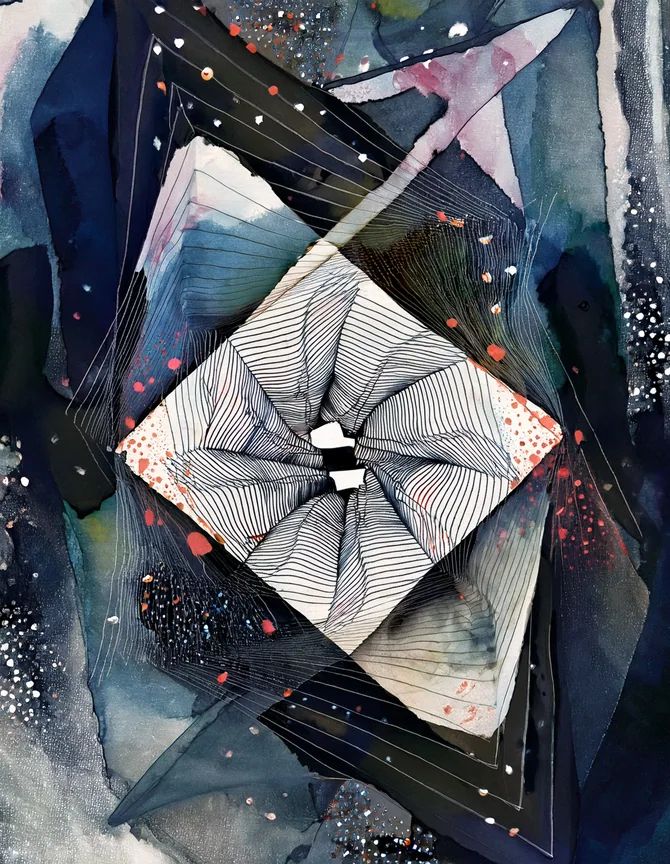
Hexagram 29 · 坎 / 習坎 Kǎn / Xí Kǎn
The Load You Do Not Put Down
Water within · Water without
You are inside a difficulty that has another difficulty inside it. The classical name is doubled — repeated pits — because the first hazard is not the whole hazard. This is not a crisis with an edge you can see. It is a condition with depth.
- Inner · Outer
- ☵ Water · ☵ Water
- Hands
- Tension · Tension
- Turned view
- Itself
- Complement
- 30 The Clinging Light
- Nuclear
- 27 The Open Mouth
This figure has thirteen parts. Six are always open here; one more opens each week.
About 600 of its 3200 words
- 01The Figure
- 02The ForcesIn the full figure
- 03The BodyIn the full figure
- 04The Situation
- 05The Interval
- 06The Family FieldIn the full figure
- 07The Facing FiguresIn the full figure
- 08Calibration
- 09The Arena Question
- 10Weather
- 11The Unhanding NoteIn the full figure
- 12The Six Lines
- 13Source NotesIn the full figure
04 · The Situation
The figure contains no relief. There is no resonance, nothing answering from another quarter, and the outer situation is the same shape as the inner one.
05 · The Interval
Here the interval is not something you enter. It is where you already are, and it will not close on its own.
Every other hexagram gives you some indication of when the gap between what is and what could be will resolve. This one does not. That is its entire instruction. The practitioner's task is not to get out of the interval but to remain structurally sound inside it for an unknown duration.
The Load You Do Not Put Down
08 · Calibration
Deficiency
premature resolution
Collapsing the tension to be rid of it; taking the first available exit and finding it opens into a deeper pit (line 1). The failure is never the difficulty — it is the flinch.
Alignment
creative holding
The load borne at exactly its weight and no more; movement in small increments; help accepted when an opening offers it (line 4); the hold filled to level and not overflowing (line 5). The held tension generating the understanding that resolution would have foreclosed.
Excess
paralysis
Holding indefinitely because holding has become an identity: bound, hedged in, three years without gain. This is the figure most likely to be mistaken for a virtue — the practitioner who cannot act has stopped carrying the load and started living in it.
Which way it tends. This figure's direction is genuinely undetermined at the cast — rare, and the whole point. Toward destructive sacrifice (lines 1, 3, 6 carry 凶 ): the cost compounds and produces nothing. Toward constructive sacrifice (lines 4, 5 carry 無咎 ): the cost is real, it is not avoided, and no fault attaches to bearing it. Which quadrant you end in is the one thing the oracle does not hold — it is in your hands.
09 · The Arena Question
What opposing forces meet here — and how many of them are actually mine?
Every place is a tension field. Some of the load in this figure belongs to the arena and predates you: an institution's contradictions, a family's unresolved inheritance, a place's history. Carrying an arena's tension as though it were personal failure is one of the most common and most costly misreadings a practitioner makes. Sort the load before you shoulder it. What opposing forces meet here — and how many of them are actually mine? The Load You Do Not Put Down
10 · WeatherOpen this week
A part from the full figure, open to everyone this week. The same figure reads differently depending on the weather you cast it in.
Dark night
the native weather of this figure, and the place where the excess reading becomes dangerous. Your own framework is explicit: in a dark night, tension may be unbearable and require support rather than more pressure. Do not read this hexagram as an instruction to endure harder. Line 4 exists precisely for this weather.
Bright day
receiving this figure on a bright day means a contradiction is present that success is currently concealing. Look for it now, while you have the resources to look.
Mundane day
the subtle, quiet, nearly invisible version: a low-grade tension carried so long it has stopped registering as tension. This is the hardest to detect and the most corrosive over time.
12 · The Six Lines
One arc: the descent into, the survival within, and the exits from a doubled difficulty. The Load You Do Not Put Down Each line, when it moves, carries the figure somewhere else.
Line 1becomes 60 The Measure →
The repeated pit; entering the pit within the pit.
You have not yet understood the shape of what you are in, and you are moving anyway.
This is the deficiency: the flinch that finds the deeper hole. The correct action at line 1 is to stop moving and establish where you actually are. The
The full reading of this line · about 120 words
Line 2becomes 8 The Holding Together →
The pit has danger; seek small gains.
Something can be done. It is small.
Do the small thing. The instruction is not consolation — it is scale calibration, and getting the scale wrong here is how line 2 becomes line 3.
The full reading of this line · about 90 words
Line 3becomes 48 The Constant Well →
Coming and going, pit after pit; danger, and resting upon it; entering the pit within the pit. Do not act.
Every available action makes it worse, including the action of leaving.
This is the position that most tests the isometric discipline, because the discipline here consists entirely of not acting, and doing nothing feels identical to failing. It isn't.
The full reading of this line · about 140 words
Line 4becomes 47 The Exhaustion →
A jug of wine, a bowl of rice, plain earthenware, handed in through the window. In the end, no fault.
In extremity, the small and unadorned offering is sufficient, and it is passed through an opening rather than the door — sideways, informally, without ceremony.
This is the line that permits asking for help, and it attaches no fault to it. Not the grand gesture, not the full account. A jug and a
The full reading of this line · about 130 words
Line 5becomes 7 The Disciplined Force →
The pit is not filled to overflowing; it is filled only to level.
This is the isometric principle, stated in the Bronze Age.
The load is carried at exactly its weight. Not more, which would be excess and would break you; not less, which would be avoidance. Filled to the rim
The full reading of this line · about 130 words
Line 6becomes 59 The Dissolving →
Bound with cords, shut in among thorns; three years without gain.
This is the excess of Tension, and the text is unusually specific: three years.
Duration is the diagnostic. The practitioner has been bound long enough that the binding has become the life, and the classical marker is the compounding one — this
The full reading of this line · about 140 words
Also in this figure
Where it lives in your body, who it moves with, and the trap it sets.

The Changes · Mikono Tisa
Sixty-four figures. Every part, every line, every painting.
730 pages · 64 original paintings · the Nine Hands mapped onto the eight trigrams · no verdicts, only trajectories.
The reading room
$5 / month
or $45 a year. The whole book online, every figure in full, 20% off readings.
Opening soon — join the letters to hear first.
The book
$50
The illustrated digital edition to keep, with three months of the reading room.
Opening soon — join the letters to hear first.
Want this figure read for your situation? Book a reading with Nathaniel